EU Age Verification App: The New Identity Primitive
The EU unveils an open-source, privacy-preserving age verification app integrated into national wallets. What it means for platforms and KYC strategy.

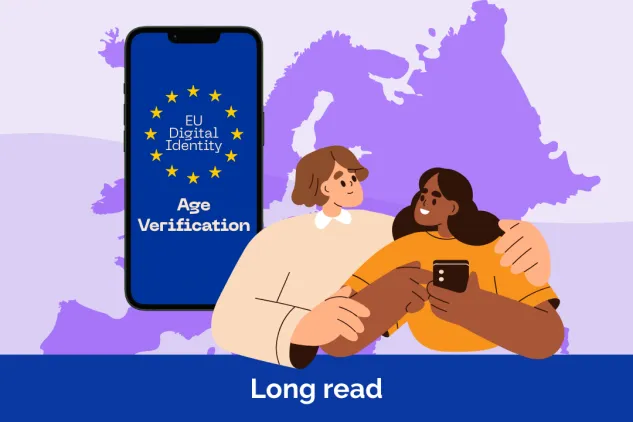
European Commission President Ursula von der Leyen said on April 14, 2026 that the EU's long-awaited age verification app is "technically ready" and that Spain, France, Denmark, Greece, Italy, Cyprus and Ireland will fold it into their national digital identity wallets. Open source. Cross-platform (iOS, Android, mobile, tablet, desktop). And — this is the part that matters — anonymous by design: adulthood can be proven without anyone learning who the user is.
Builders of digital products in the EU should not treat this as a side note. A supranational regulator has, for the first time, shipped a production-grade identity primitive that sits in front of every platform that needs an age gate. The timing is not accidental. It arrives while the Commission is already pressing Pornhub, Stripchat, XNXX and XVideos over alleged Digital Services Act (DSA) breaches tied to protecting minors.
Joinble has spent two years making the case that identity is turning into an agentic, wallet-native layer. That thesis just got a public confirmation — and every platform now has to revisit how age, identity and consent fit together.
What the EU age verification app actually does
A zero-knowledge age proof is what the app produces. Users are not asked to send an ID or a selfie to each adult site. A cryptographic credential — "this person is over 18" — is issued instead, and the user shows it to platforms when asked.
| Feature | Design choice |
|---|---|
| Proof model | Anonymous, unlinkable, no tracking |
| Distribution | National eID wallets (ES, FR, DK, GR, IT, CY, IE first) |
| Platforms | iOS, Android, desktop, tablet |
| Licensing | Open source |
| Enforcement hook | Digital Services Act (DSA) |
| Scope | Social media, adult content, plus extensible to gambling, alcohol, crypto |
Privacy architecture is the point, not an afterthought. Earlier age-gating efforts collapsed for a simple reason — a passport uploaded to a porn site, for instance — because they piled sensitive data into the organisations least able to guard it. The EU flipped the model: the wallet issues a proof, the platform receives a boolean, and no personal data changes hands.
We already walked through this cryptographic pattern in biometric age verification without surveillance. It is now written into regulation at continental scale.
Why this is happening now: the DSA enforcement wave
Subtlety is not the Commission's style here. Alongside the app launch, Brussels formally accused Pornhub, Stripchat, XNXX and XVideos of failing to protect minors adequately under the Digital Services Act. Those services are Very Large Online Platforms (VLOPs) in Commission language, and DSA penalties go as high as 6% of global annual turnover.
Tool and stick move together. The Commission is delivering the wallet-based age verification app and going after platforms that skip it — or skip an equivalent.
A wider pattern shows up in our reporting on Discord's global age verification rollout: self-declaration checkboxes no longer satisfy regulators. Cryptographically verifiable age assurance is the expectation, and it is expected to preserve privacy.
Who is affected (beyond adult content)
Adult sites and social networks sit in the obvious line of fire. DSA-adjacent rules and neighbouring regulation reach much further than that:
- Social platforms — TikTok, Meta, Snap, Discord: already under DSA risk assessments for minors
- Gambling and betting — every regulated operator in the EU must age-gate
- Crypto exchanges and Web3 platforms — under MiCA, age and identity are inseparable
- Alcohol and e-commerce — any SKU with a legal minimum age
- Gaming and in-game purchases — especially around loot boxes
- Streaming and video platforms — PEGI-rated content gating
- AI companions and chat products — the next frontier of regulator scrutiny
An age gate on your product today — even a flimsy one — now has a regulator-endorsed alternative sitting next to it. You also have a clock running until someone in Brussels asks why you are not using it.
The "agentic identity" thesis, validated
agentic KYC, as we have framed it, is the move away from passive, form-based verification toward autonomous AI agents that negotiate identity proofs for users and platforms. The EU's app is that architecture in textbook form — except the issuer is the state, not a private vendor.
Three shifts are now locked in:
- Identity moves into the wallet. Passport uploads at every new signup will stop being tolerated. The wallet is the single source of truth.
- Claims, not documents, travel over the wire. Attested claims ("is adult", "is resident of X", "is not on sanctions list") arrive at the platform; raw PII does not.
- The verification layer becomes agentic. Which claim is required, which issuer to trust, and what residual risk is left — Joinble's AI Agents orchestrate that in real time, at onboarding and after.
Half the stack came from the EU. Orchestration, risk scoring, and transaction-time re-verification — the other half — still need a dedicated KYC layer on the platform side. A zero-knowledge age proof will not tell you if the wallet holder is under coercion, if the device is running a deepfake pipeline, or if the account is a synthetic identity mule inside a larger ring.
How platforms should prepare
A practical roadmap, if you operate in the EU or serve EU users from elsewhere:
1. Map your age-gating exposure
Every user flow with a legal age-assurance duty should be listed. Teams routinely miss this: signup is only one surface. Purchase, content unlock, ad serving, and account recovery count too.
2. Integrate the EU app as the preferred path
The wallet-issued proof should be the default flow wherever it is available in the user's country. Cheaper, faster, and as privacy-preserving as the design gets. Conversion improves when friction drops — and 60%+ of EU adults already hold an eID.
3. Keep a robust fallback
Day one will not cover 100% of users. Non-EU visitors, guardians of minors, residents of states that have not joined yet, and people without a national eID still need another path. Document + biometric + liveness from a KYC provider remains essential there — our KYC 3.0 framework covers that gap.
4. Decouple age from identity in your data model
"date of birth" as a column is how most platforms still store this. The replacement pattern: persist an attested claim ("is_adult_verified_by: EU-wallet, expires: 2027-04-14, proof_hash: …") and nothing else. Architecturally this is a one-way door — plan it now.
5. Layer behavioral and agentic signals on top
Point-in-time is all an age proof is. Account takeover, shared credentials and coercion do not go away. Session-level signals watched by AI Agents close that gap on a continuous basis, without asking the user again.
6. Treat this as a trust-and-safety win, not just compliance
Shipping wallet-native age verification before a mandate lands tells regulators and advertisers you are serious. The same logic as why KYC is no longer just for banks: identity assurance is becoming a brand asset.
What's next: from age to full attribute attestation
Age is the wedge. That same wallet infrastructure is already stretching toward:
- Residency (for geofencing and tax)
- Accredited investor status (for tokenization and asset tokenization flows)
- Professional licenses (for B2B marketplaces)
- KYC re-use (a bank-verified identity, portable to other regulated services)
eIDAS 2.0 predicted the whole sequence. Consumer-facing proof that the architecture actually ships arrived first as the age verification app.
The Joinble take
Identity turning into infrastructure — open, cryptographic, wallet-based, regulator-issued — is the clearest signal yet, and the EU age verification app is it. Joinble's AI Agents were built for that world: they orchestrate wallet-issued claims, fill gaps with document and biometric flows where the wallet does not reach, and keep watching risk after the onboarding event.
Platforms with an age gate (which, more and more, means every platform) are past the whether of wallet-based verification. The live question is how fast you can add it without wrecking existing KYC, UX, or risk posture.
Fast, we would say — provided a real agentic layer sits underneath. Otherwise one checkbox has merely replaced another.
FAQ
When will the EU age verification app be live?
On April 14, 2026 the Commission said the app is "technically ready." Spain, France, Denmark, Greece, Italy, Cyprus and Ireland get the first integration into national wallets; remaining member states come later.
Is the app mandatory for platforms?
Mandatory, the app itself is not. Under the Digital Services Act, platforms that serve minors still owe the outcome — effective, privacy-preserving age assurance. Demonstrating compliance is simplest if you use the EU app.
Does the app reveal the user's identity?
No. A zero-knowledge proof is issued — typically a boolean "is adult" — with no name, no date of birth, and no other personal data disclosed. That is the core design principle.
What happens to platforms that don't comply?
VLOPs under the DSA can be fined up to 6% of global annual turnover. Formal accusations over minor-protection violations have already been issued by the Commission against Pornhub, Stripchat, XNXX and XVideos.
Do we still need a KYC provider if the EU app exists?
Yes. Age assurance for EU users who hold a wallet is what the app solves. Full KYC for onboarding, AML screening, document verification for non-wallet users, biometric liveness against deepfakes, and ongoing risk monitoring remain necessary — the work Joinble's AI Agents are built to do.
Will this model extend beyond age?
Yes. Under eIDAS 2.0, the same wallet infrastructure is designed for residency, accredited investor status, professional credentials and portable KYC. Age shipped first; the remaining use cases are already in the pipeline.
Ready to make wallet-issued identity part of your onboarding stack? Joinble can walk you through how our AI Agents put EU wallet proofs next to full KYC, biometrics and continuous risk monitoring — DSA enforcement stays in front of you, UX does not have to give way.
Related Articles

Discord's Global Age Verification Challenge
Discord announces an age verification system for its 150 million users. We analyze the impact on privacy, minor safety, and how KYC technology is redefining social networks.

Biometric Age Verification: Protecting Minors Without Surveillance
Biometric age verification can protect minors online without identifying users or sharing data with governments. The key is privacy-first architecture.

UK AML 2026: New Rules for Crypto, Effective June 30
Parliament approved 15 UK AML reforms on June 9. Most take effect June 30. Crypto firms face the deepest changes. Here's your compliance checklist.