No Single Signal Wins: Layered Biometric Verification
Deepfakes now drive 1 in 5 biometric fraud attempts. Regula and AU10TIX pivoted to layered multimodal verification in July 2026. Here's what changed and why.



A foundational assumption in identity verification quietly collapsed over the last twelve months: that one biometric signal — a face, a fingerprint, a selfie — could hold a trustworthy identity decision in place.
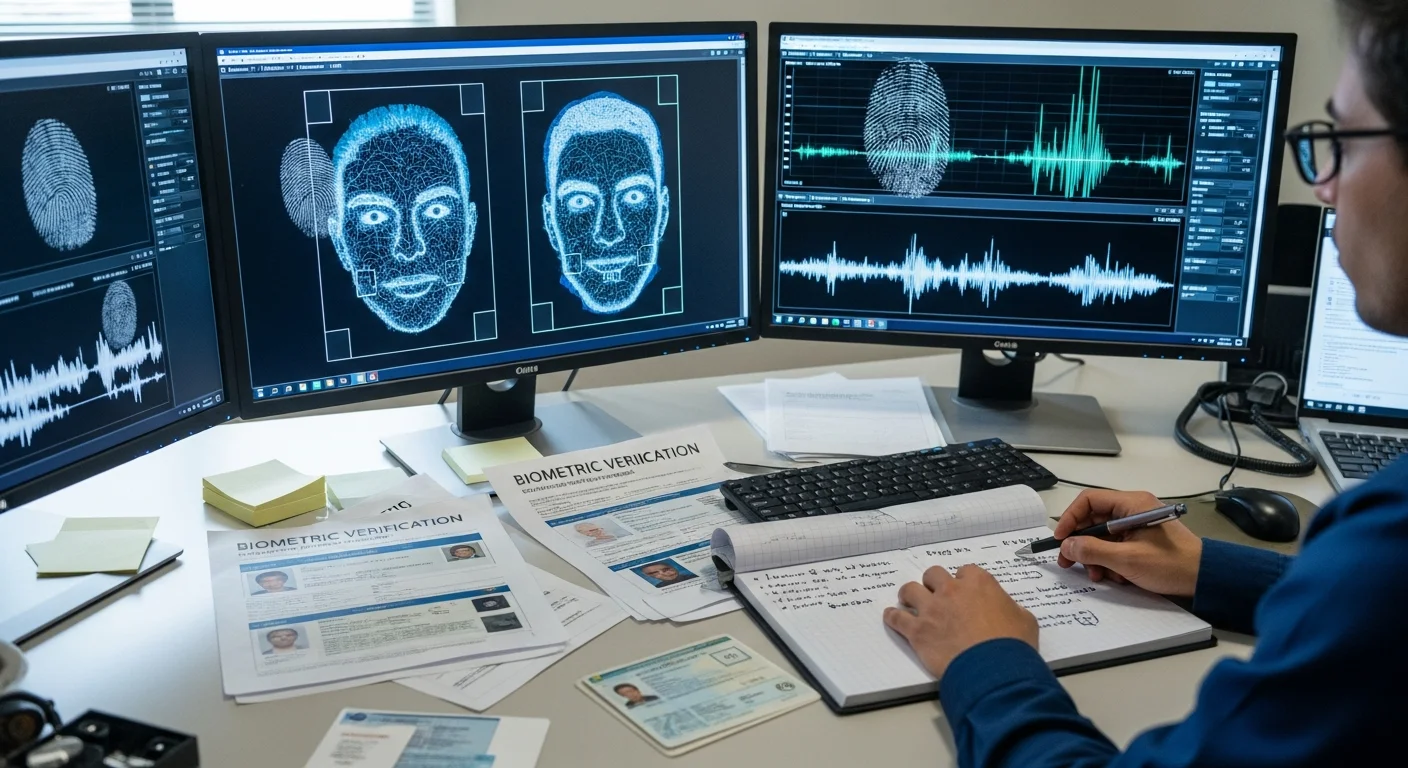
Two major announcements in July 2026 confirmed the shift. An enhanced multimodal biometric verification service from Regula Forensics now combines facial recognition, fingerprint verification, iris recognition, voice recognition, behavioral biometrics, and hand geometry analysis inside a single orchestration layer. Days earlier, AU10TIX announced a collaboration with Validit.ai that adds physio-behavioral AI as a real-time fraud intelligence layer. Subtle physiological signals are read through a standard device camera to determine whether a human being is genuinely present and not scripted.
Those launches are not product upgrades. They are industry admissions that the single-signal verification model has broken down.
The Numbers Behind the Shift
The data behind the transition is stark.
According to Entrust's 2026 Identity Fraud Report, deepfakes now drive 1 in 5 biometric fraud attempts globally. Losses from deepfake fraud reached $3.7 billion worldwide. Of all recorded losses, 89 percent sit in 2025 and 2026 alone — a concentration that reflects an exponential acceleration, not a linear trend.
A single financial institution logged 8,065 deepfake attempts across an eight-month window, tied to $347 million in verified losses from that threat vector. More troubling still is Biometric Update's July 2026 analysis: more than half of organizations cannot fully verify that biometric data was captured live. Liveness checks are running against data whose provenance those organizations cannot establish.
Attackers have learned to exploit that structural vulnerability at scale.
Why Single-Signal Verification Fails
Even a sophisticated biometric check, if it stands alone, is a single point of failure. An attacker who understands how a specific signal is evaluated can engineer a synthetic version that passes that specific evaluation.
Face liveness detection was the first casualty. Camera injection tools do not attack the liveness algorithm, as we examined in detail in our analysis of why liveness detection fails against injection attacks. They bypass the physical sensor entirely and feed synthetic video data directly into the application's API pipeline. Structurally valid data reaches the PAD algorithm. Nothing in that algorithm can tell injected input from genuine sensor output.
Voice biometrics followed. The Mercor breach in April 2026 showed why: 40,000 voice recordings and paired identity documents were stolen from a single platform, and every voice verification system that relied on those individuals became a potential attack surface. Stolen biometrics enable attacks that no voice liveness algorithm can catch. The voice itself is authentic. It simply does not belong to the person presenting it.
Across modalities, the pattern repeats. Isolated evaluation answers a narrow question. "Does this face look like a live human?" says nothing about whether that face belongs to the person claiming the identity, or whether the camera data was captured in this session. "Does this voice match?" says nothing about whether the voice sample was stolen.
Most compliance teams understand this less well than attackers do.
Regula's Multimodal Architecture
Independent signal types, combined so that defeating one does not defeat the system: that is the industry's emerging answer, and Regula's July 2026 service reflects it.
Six distinct biometric modalities sit in the architecture — face, fingerprint, iris, voice, behavioral patterns, and hand geometry — next to identity document verification, NFC chip reading, and session risk analysis. Different questions get different answers from each modality. Each one supplies an independent form of evidence. Confidence that no single modality can produce alone comes from correlating that evidence across modalities.
The system is designed, crucially, for deployment inside multi-layered verification workflows. Document authenticity checks, NFC verification, risk scoring, and exception routing sit alongside biometric matching. A session that passes face liveness but triggers behavioral anomalies can be flagged for enhanced review rather than automatically approved. That is the architecture injection attacks are designed to defeat. Multi-signal correlation defeats them for a simple reason: compromising one layer does not compromise the decision.
Physio-Behavioral AI: The Human Authenticity Layer
Real-time human authenticity verification through physiological and behavioral signals is a category that did not exist at enterprise scale two years ago. The AU10TIX and Validit.ai collaboration introduced it.
Signals are analyzed through a standard device camera — not a specialized sensor — by Validit.ai's technology, which generates real-time indicators of human presence, attention, and authenticity that operate independently of facial recognition. Two checks run together: whether physiological signals consistent with a live human being are present, and whether behavioral patterns across the session look like genuine user engagement or like scripted, automated, or synthetic interaction.
Traditional liveness detection is distinct from this in an important way. Liveness detection asks: "Is this image or video of a live face?" Physio-behavioral analysis asks: "Is a real human being engaged with this session right now?" Faking the second question is much harder. A convincing face is not enough; a convincing body of behavioral evidence has to be synthesized across the full duration of the interaction.
High-risk use cases — financial services onboarding, buy-now-pay-later approvals, account recovery, insurance claims — are where this layer closes the gap that synthetic identity fraud most aggressively exploits. A fraudster who has assembled a complete synthetic identity still has to engage with a verification system in real time. That is the point this layer targets.
The Five Layers of a Resilient Identity Stack
July 2026 announcements point toward an industry consensus around a five-layer model that KYC architects should evaluate:
Layer 1 — Document authenticity. OCR, MRZ parsing, document template validation, UV and infrared artifact detection, and NFC chip verification where available. This layer answers: "Is this document genuine?"
Layer 2 — Biometric matching. Facial recognition against the document photo, with multimodal extensions (voice, fingerprint, iris) for high-assurance scenarios. This layer answers: "Does this biometric match the claimed identity?"
Layer 3 — Liveness and injection detection. Passive liveness, active challenge-response, and — critically — sensor authentication to establish that biometric data originated from a genuine device sensor rather than an injected synthetic stream. This layer answers: "Is this data from a live person in this session?"
Layer 4 — Physio-behavioral assurance. Real-time analysis of physiological and behavioral signals across the session duration. This layer answers: "Is a real human being genuinely present and engaged?"
Layer 5 — Continuous session and risk monitoring. Device fingerprinting, IP reputation, behavioral velocity checks, and anomaly detection that persist beyond the onboarding moment. This layer answers: "Does this session's behavior remain consistent with a legitimate user?"
Independence is the point of each layer. Layer 4 still stands if Layer 3 falls. Layer 1 still stands if Layer 2 falls. Every layer has to be defeated at the same time, and that problem scales adversarial cost exponentially.
The AI Agent Advantage
Layers 1 through 3 sit reasonably well inside static verification. Layers 4 and 5 ask for something else: continuous, real-time analysis that persists across the customer lifecycle, not only at the onboarding gate.
AI agents hold a structural advantage over rule-based monitoring systems there. Behavioral baselines can be evaluated across sessions. Transaction-pattern anomalies that surface weeks after a clean onboarding can be flagged. Edge cases can go to human review with full context, instead of sitting until a threshold-based alert fires.
Joinble's AI agents operate across the full customer lifecycle and apply continuous identity assurance well beyond the onboarding gate. Login patterns, transaction velocity, device fingerprint, geographic signals — if a verified customer's behavior diverges from the established baseline, the agent evaluates the deviation in context and acts. Step-up verification, session suspension, or human review, each calibrated to the risk profile.
Account takeover fraud is the threat that architecture has to answer. An identity that was legitimate at onboarding and compromised six months later will not be caught by point-in-time verification.
Implications for Regulated Industries
Under EU AML framework obligations, financial institutions are watching the layered model become a de facto compliance standard, not merely a fraud reduction strategy. Submitted to the European Commission in July 2026, AMLA's Customer Due Diligence technical standards emphasize identity verification architectures that keep assurance in place across the customer relationship — not only at onboarding.
MiCA travel rule enforcement puts a similar requirement on crypto asset service providers. High-value transactions need continuous identity assurance. A one-time biometric check at account opening is not enough.
Real estate and RWA tokenization platforms face an asymmetric cost if single-signal verification fails: one fraudulent beneficial owner can compromise a multi-million euro transaction. Implementing a four- or five-layer verification architecture does not carry that same asymmetry.
The Signal the Industry Is Sending
Architectural pivots toward multimodal, layered verification from both Regula and AU10TIX in the same month send compliance teams a clear message. The single-signal model is no longer adequate. The attacker ecosystem has already adapted.
KYC bypass-as-a-service tools aimed at major exchanges are not experimental. They are commercially available, actively maintained, and pre-configured for specific verification systems. Adversarial innovation outruns the compliance update cycle. Waiting for regulatory mandates before adopting layered verification is waiting until after the damage is done.
"Do we need liveness detection?" is not the identity verification architecture question in 2026. That question was answered three years ago. The question now is: "Which layers do we need, and how do we orchestrate them so that defeating one does not defeat the decision?"
FAQ
Why is single-signal biometric verification no longer sufficient? Individual biometric signals can now be synthesized by AI tools with enough fidelity to defeat isolated checks. Face liveness is passed by deepfakes. Voice matching is passed by stolen voice recordings. Sensor-level detection is bypassed by camera injection tools. Attackers facing a layered system have to defeat every independent signal at once, which dramatically increases the cost and complexity of fraud.
What is physio-behavioral biometric verification? Physiological signals — subtle movements, micro-expressions, involuntary responses — plus behavioral patterns across a session, rather than a single captured image or recording, are what this category of biometric assurance analyzes. Validit.ai and similar companies generate those signals from standard device cameras, without specialized hardware.
What is multimodal biometric verification? Face, voice, fingerprint, iris, and behavioral patterns are combined as independent biometric modalities, so no single modality is a single point of failure. Evidence correlated across independent channels produces higher-confidence identity decisions than any one modality can produce alone.
How do AI agents improve on static biometric verification? A point-in-time question is what static verification answers. Continuous monitoring of the customer relationship is what AI agents do, catching behavioral anomalies that appear after a clean onboarding — account takeover, session hijacking, gradual identity drift — and triggering appropriate responses in real time.
Which industries need layered biometric verification most urgently? Financial services, crypto asset service providers (MiCA-regulated), real estate transaction platforms, insurance, and any high-value digital marketplace in which a single fraudulent identity event carries significant financial or regulatory consequences.
When do AMLA's new CDD standards apply? Draft Regulatory Technical Standards on Customer Due Diligence were submitted by AMLA to the European Commission in July 2026. From July 10, 2027 they apply directly across all 27 EU member states, with no national grace periods.
Related Articles
Face Alone Is No Longer Proof: Multimodal Liveness in KYC
Deepfake losses hit $3.7B in 2026. Here is why single-signal biometric liveness checks are failing — and what multimodal KYC verification requires.

Biometric Age Verification: Protecting Minors Without Surveillance
Biometric age verification can protect minors online without identifying users or sharing data with governments. The key is privacy-first architecture.

Fraud Rings Now Recycle Identities Across KYC Systems
Shufti's September 2026 report exposes how organised fraud rings share devices, IP addresses, and forged identities to defeat KYC at scale.