AI-Generated Fake IDs: The New Frontier of Identity Fraud
ChatGPT can create a fake passport in 5 minutes. OnlyFake sold 10,000+ AI-generated IDs. Learn how synthetic documents bypass KYC and what defenses actually work in 2026.

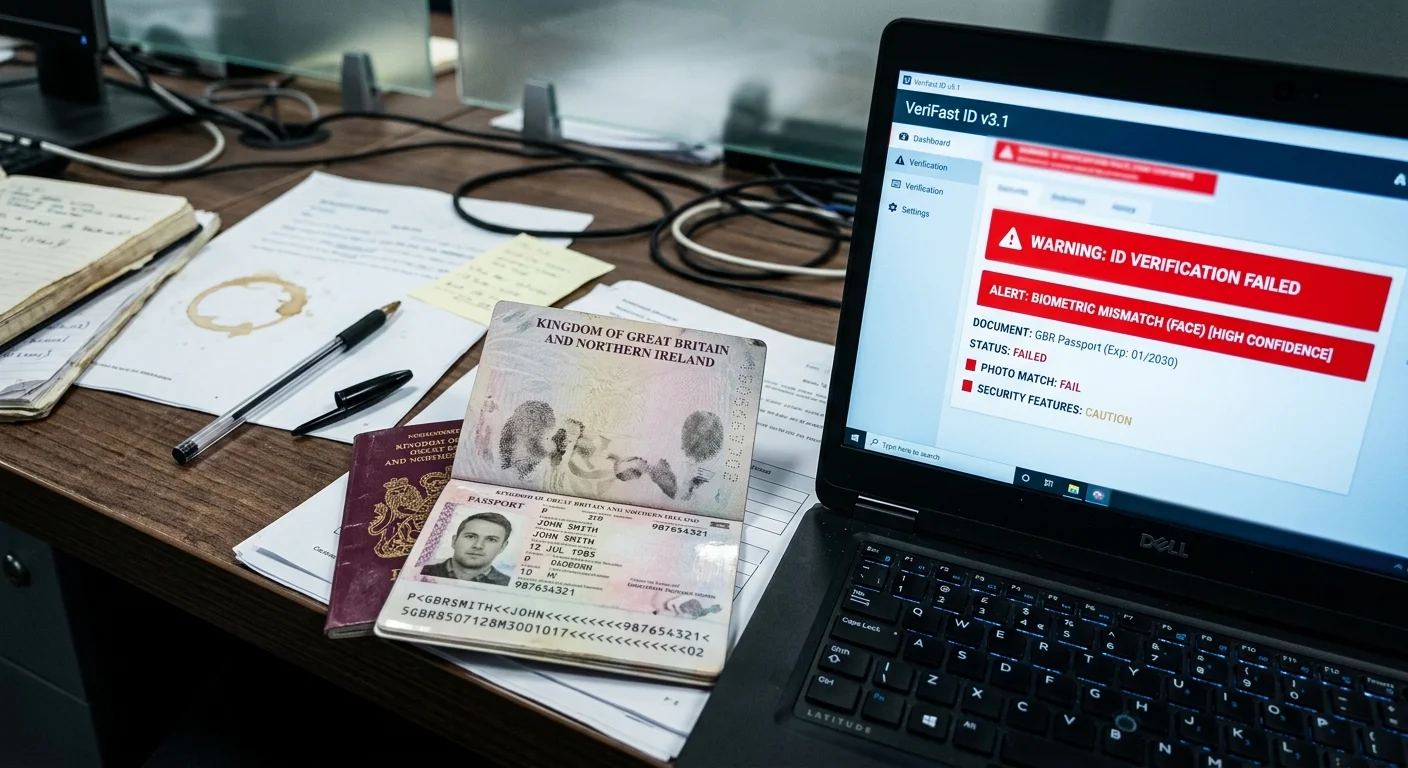
In April 2025, a Polish security researcher opened ChatGPT, typed a few prompts, and generated a fake passport in five minutes. No jailbreak. No dark web tools. Just a consumer AI product and a bit of creativity. The fake document passed automated KYC checks on fintech platforms like Revolut and Binance.
That experiment was a proof of concept. Twelve months later, it is an industry.
The era of AI-generated identity documents has arrived, and it is forcing every company that relies on photo-based KYC to rethink its entire verification architecture. At Joinble, we have been tracking this threat since 2024 and building defenses against it. This article explains the current state of AI-generated fake IDs, real cases, and the technologies that actually stop them.
The $15 Fake ID: How We Got Here
Identity document fraud is not new. What is new is the cost, speed, and quality of AI-generated fakes.
Three years ago, creating a convincing fake ID required Photoshop expertise, knowledge of document security features, and hours of manual work. Today, generative AI models produce documents that include:
- Correct MRZ (Machine Readable Zone) codes that pass automated validation
- Realistic micro-textures and holograms rendered by diffusion models
- Consistent metadata and EXIF data that match legitimate document patterns
- Matching selfies generated by the same AI to pass biometric checks
According to Sumsub's 2024 Identity Fraud Report, fake IDs and forged documents accounted for 50% of all identity fraud attempts. The cost to produce one has dropped to as little as $15.
The barrier to entry has collapsed. You no longer need to be a skilled forger. You need a subscription.
The OnlyFake Case: Fraud-as-a-Service
The most significant case in the AI fake ID space is OnlyFake — a subscription-based platform that used artificial intelligence to generate realistic counterfeit passports, driver's licenses, and Social Security cards.
The operation:
- Supported driver's licenses for all 50 U.S. states, U.S. passports, and identity documents from over 50 countries
- Generated at least 10,000 fake identification documents between 2021 and 2024
- Accepted only cryptocurrency payments and offered bulk packages of up to 1,000 documents at a discount
- Brought in hundreds of thousands of dollars in revenue
The outcome:
Yurii Nazarenko, a 27-year-old Ukrainian national, was arrested in Romania and extradited to the United States in September 2025. He pleaded guilty in the Southern District of New York and faces up to 15 years in prison. He agreed to forfeit $1.2 million in proceeds. Sentencing is scheduled for June 26, 2026.
OnlyFake was not an anomaly. It was a business model. And while the platform was shut down, underground markets now offer "bypass-as-a-service" packages — combining AI-generated documents with deepfake videos — for $30 to $600.
The ChatGPT Moment: When Consumer AI Became a Forgery Tool
The OnlyFake operation required a dedicated platform. What changed everything was the realization that mainstream AI tools can do the same thing.
In April 2025, security researcher Borys Musielak demonstrated that ChatGPT-4o's image generation capabilities could create a convincing replica of his own passport in just five minutes. The key findings:
- No jailbreak was required — standard prompts were sufficient
- The generated document passed basic KYC checks used by fintech platforms
- The fake included realistic photo, fonts, layout, and security features
- A matching selfie could be generated separately to defeat biometric matching
OpenAI responded within hours by blocking similar document forgery requests. But the damage was conceptual: if the world's most popular AI chatbot can produce fake IDs with no specialized knowledge, any generative AI model can be fine-tuned to do the same.
This is not a ChatGPT problem. It is a generative AI problem. Open-source models like Flux and Stable Diffusion have no content policy to enforce. Specialized fine-tuned models circulate on underground forums with no restrictions at all.
Why Traditional KYC Cannot Stop This
Most KYC systems were designed for a world where fake documents were physically manufactured. Their verification logic assumes:
- A real camera captures a real document
- The document image matches known templates
- OCR extracts data that matches the MRZ
- A selfie matches the document photo
AI-generated fake IDs satisfy every one of these checks. The document looks correct. The MRZ validates. The selfie matches because both were generated by the same model.
As one industry executive stated: "AI has fully defeated most of the ways that people authenticate currently."
The specific failures:
| Verification Method | Why It Fails Against AI Fakes |
|---|---|
| Photo matching | AI generates document and selfie as a pair |
| OCR + MRZ validation | AI generates valid, consistent data |
| Template matching | Diffusion models replicate templates precisely |
| Human review | Trained reviewers cannot reliably distinguish AI fakes |
| Liveness detection (basic) | Deepfake video injection defeats standard checks |
Expecting human eyes to catch AI-crafted forgeries is, as Help Net Security reported in February 2026, "a losing battle."
The Full Attack Chain: Documents + Deepfakes + Automation
The real threat in 2026 is not a single fake ID. It is the complete synthetic identity package — and it is fully automated.
Stage 1: Document Generation
AI generates a government ID with consistent data, valid MRZ, and realistic security features. Cost: $15-30. Time: under one minute.
Stage 2: Biometric Bypass
A deepfake video matching the document photo is generated for liveness checks. Real-time face swap technology allows the fake identity to pass video verification calls. This builds on the deepfake injection techniques already targeting bank onboarding.
Stage 3: Mass Automation
AI agents orchestrate thousands of simultaneous onboarding attempts across different platforms, each with a unique synthetic identity. This is the Fraud 4.0 model — AI attacking at scale.
Stage 4: Monetization
Successfully created accounts are used for money laundering, loan fraud, crypto exchange manipulation, or sold as "aged accounts" on underground markets.
The entire pipeline — from document generation to account opening — can be executed without human intervention. The attacker is not a person. It is a system.
What Actually Works: Defenses That Stop AI-Generated Fakes
If photo-based verification is "officially obsolete," what replaces it?
1. NFC Chip Verification
Electronic passports and national ID cards contain RFID/NFC chips with cryptographically signed data from the issuing government. This data cannot be forged because:
- The private signing keys are held by issuing authorities
- The chip contains a digitally signed photograph, fingerprints, and personal data
- Verification confirms the data has not been tampered with since issuance
Over 140 countries now issue NFC-enabled passports. Reading the chip during verification defeats AI-generated documents entirely — no AI can forge a government cryptographic signature.
Limitation: Not all identity documents have NFC chips (driver's licenses in most countries, older passports), and not all users have NFC-capable devices.
2. Forensic AI Detection
This is where agentic KYC systems provide a critical advantage. Instead of checking whether a document looks correct, forensic AI analyzes whether it was created by a generative model:
- Neural artifact detection — identifies microscopic patterns left by diffusion models and GANs that are invisible to human eyes
- Frequency analysis — AI-generated images have distinctive frequency domain signatures that differ from camera-captured photos
- Metadata forensics — analyzes compression artifacts, color profiles, and pixel-level anomalies inconsistent with genuine camera output
- Rendering consistency checks — detects subtle inconsistencies in lighting, shadows, and texture that generative models struggle to perfect
At Joinble, our Forensic AI Agent runs these checks on every verification case — not just flagged ones. This is critical because the most dangerous fakes are the ones that don't trigger initial suspicion.
3. Multi-Signal Verification
No single check is sufficient. Effective defense in 2026 requires correlating multiple independent signals:
- Document authenticity (forensic AI + NFC when available)
- Biometric liveness (injection detection, not just liveness prompts)
- Device integrity (is the camera feed coming from a real device or a virtual camera?)
- Behavioral analysis (interaction patterns that automated systems cannot naturally replicate)
- Network and device fingerprinting (identifying fraud rings using the same infrastructure)
This layered approach is what makes agentic KYC architecture fundamentally different from traditional verification. Multiple specialized AI agents analyze different dimensions simultaneously, and a single compromised check does not compromise the entire verification.
4. eIDAS 2.0 and Digital Identity Wallets
The EU Digital Identity Wallet, mandated under eIDAS 2.0, will allow citizens to present verified identity credentials directly from their phone. Because the credentials are issued by government authorities and cryptographically bound to the holder's device, they eliminate the document image attack vector entirely.
This is the long-term architectural solution, but full deployment is not expected until 2027-2028.
What Companies Should Do Now
If you rely on photo-based KYC:
You are vulnerable. AI-generated documents will pass your checks. The question is not if, but how many already have.
Immediate actions:
- Add forensic AI detection to your verification pipeline — check every document for generative AI artifacts, not just flagged cases
- Implement NFC verification as the primary method for electronic documents, falling back to forensic AI for non-NFC documents
- Deploy injection detection on your liveness checks — verify that the video feed comes from a physical camera sensor, not a virtual camera
- Monitor for synthetic identity patterns — bulk account creation attempts, shared device fingerprints, velocity anomalies
- Prepare for eIDAS 2.0 — architect your system to accept EU Digital Identity Wallet credentials as they become available
The cost of inaction:
With MiCA enforcement requiring full KYC/AML compliance for CASPs and AMLR introducing harmonized requirements across the EU, a verification failure is not just a fraud loss — it is a regulatory violation with fines up to 12.5% of turnover.
The Arms Race Is Already Here
AI-generated fake IDs are not a future threat. They are a current reality that has already defeated photo-based verification. The OnlyFake case showed the scale. The ChatGPT experiment showed the accessibility. Underground markets show the commercialization.
The companies that survive this transition will be those that stop treating document images as proof and start treating them as claims to be forensically verified. At Joinble, our multi-agent KYC architecture was designed for exactly this scenario — where the attacker is not a person with Photoshop, but an AI system producing thousands of synthetic identities per day.
The identity verification industry has a choice: evolve the architecture, or watch AI-generated fraud scale faster than manual review teams can hire.
FAQ
Can ChatGPT really create a fake passport?
Yes. In April 2025, a security researcher demonstrated that ChatGPT-4o could generate a convincing fake passport in five minutes using standard prompts. OpenAI blocked similar requests within hours, but open-source AI models have no such restrictions.
How much does an AI-generated fake ID cost?
As little as $15 for a single document. Underground platforms like OnlyFake offered bulk packages of up to 1,000 documents at a discount. "Bypass-as-a-service" packages combining fake documents with deepfake videos range from $30 to $600.
Can human reviewers detect AI-generated fake IDs?
Increasingly, no. AI-generated documents now include realistic security features, valid MRZ codes, and matching metadata. Industry experts and recent research confirm that expecting human reviewers to reliably catch AI-crafted forgeries is no longer realistic.
What is NFC verification and why does it stop AI fakes?
NFC verification reads the cryptographically signed data stored in the chip of electronic passports and ID cards. Because the data is signed with government-held private keys, it cannot be forged by AI. Over 140 countries issue NFC-enabled passports.
How does forensic AI detect AI-generated documents?
Forensic AI analyzes images at the pixel level for artifacts specific to generative AI models — frequency domain anomalies, neural rendering patterns, metadata inconsistencies, and compression artifacts that differ from camera-captured photos.
Is photo-based KYC still safe?
No. Any verification flow that relies solely on document images and selfie matching is now considered vulnerable to AI-generated fraud. Multi-layered verification combining forensic AI, NFC, liveness detection, and behavioral analysis is the current best practice.
Stay up to date on AI & KYC
Get the best articles on artificial intelligence, identity verification and compliance delivered straight to your inbox.
Related Articles
Fraud 4.0: The Great Battle between Forensic AI and Malicious Agents
In 2026, digital identity faces a new threat: AI agents designed to deceive other verification systems.

5 ways deepfakes are attacking bank onboarding in 2026
Identity fraud has evolved. Discover the most advanced tactics criminals use to bypass bank security and how Joinble's forensic AI is the answer.