Visa Launches Agentic Ready: AI-Powered Autonomous Commerce Gets Payment Infrastructure
Visa introduces its Agentic Ready program in Europe with 21 issuing banks. We analyze what it means for identity verification, KYA, and digital trust in agentic commerce.



Visa Agentic Ready is now live as a global program, Visa has announced, built so the full payments ecosystem can handle a new pattern: AI agents that buy, book, and pay for consumers without those consumers in the loop. The United Kingdom is included as Europe becomes the first market to go live.
The work sits inside Visa Intelligent Commerce, the company's strategic frame for AI-driven commerce experiences. Issuers come first in this opening phase: banks and financial institutions that must learn to validate and authorize payments started not by a person, but by an algorithm.
This is not a proof of concept. One of the world's largest payment networks has, for the first time, published a formal, standardized framework for autonomous transactions — a clear signal that the agent economy is entering its defining year.
How agentic commerce works
Between merchant and consumer, an AI agent sits as intermediary. Give it an instruction — "buy the cheapest flight to Lisbon next Friday" — and it runs the transaction end to end with no further human step.
The payments sector faces a three-part problem:
- Security: confirming the transaction is genuine and not an impersonation.
- Traceability: tying every payment, without ambiguity, to a real person.
- Revocability: leaving room for the consumer to step in and cancel at key moments.
Visa backs the program with its trust layer: credential tokenization, biometric authentication, real-time risk management, and user controls. Each agent-initiated payment should, by design, attach to a real person who gave explicit consent.
21 European banks are already on board
Banco Santander, Revolut, Barclays, HSBC UK, Commerzbank, Nationwide, Nexi Group, Raiffeisen Bank International, Millennium BCP, Alpha Bank, plus eleven further banks across Europe, sit among the first confirmed issuers.
A real purchase has already run at Banco Santander: a book bought with a Visa Santander Spain card, handled entirely by an AI agent. Matias Sanchez, the bank's Global Head of Cards, calls it a "key enabler of secure and interoperable agentic commerce within a connected payments ecosystem."
Revolut has drawn a similarly sharp line. Rom Jackson, Head of Card Payment Product, says: "As AI evolves into an active purchasing tool, the underlying payments infrastructure must keep pace."
Why Europe is the testing ground
Europe as launch market is a deliberate pick:
- High adoption of tokenization and passkeys, the two foundational technologies for the program.
- Mature regulatory framework with PSD2, eIDAS 2.0, and current AML regulations.
- Committed issuing partners with a structured roadmap and real timelines.
Selected merchants will see tests in live production — not simulations. North America, Asia-Pacific, the Middle East, and Latin America already have the program as well, yet Europe still leads on execution.
The missing link: verifying the agent's identity
The payments half is what Visa's program covers. A second question, still without a standardized industry answer, is now open: if an AI agent acts on behalf of a person, how do we verify that delegation is legitimate?
KYA (Know Your Agent) is the concept that fills that gap — KYC extended into autonomous agents. Traditional KYC confirms a person is who they say they are. KYA has to confirm that:
- The agent is authorized by a real person verified biometrically.
- The delegation has defined limits: maximum amounts, permitted purchase categories, time windows.
- The person-agent link is traceable: a dispute or audit must still have an evidence chain from each transaction back to the original consent.
- The agent has not been tampered with: prompt injection attacks, model impersonation, or alteration of original instructions must be detectable.
Tokenization and user controls let Visa cover part of this. Forensic identity verification that binds the agent to its human owner is a further layer payment networks do not supply on their own.
How forensic identity verification fits in
That intersection of verified identity and agentic commerce is where Joinble has been working for months. Three principles structure our approach:
Biometric verification of the delegator
An agent cannot operate until the person granting authority completes a forensic identity verification: official document, biometric selfie, and liveness detection with pixel-level anti-deepfake analysis. Delegation then originates from a real person, not a synthetic identity.
Immutable delegation record
A timestamp, permission scope, and cryptographic hash are stored with every authorization. Purchases the agent tries outside those authorized parameters are flagged before they reach the payment network.
Continuous monitoring
A single check is not verification. Agents run over time, and circumstances shift. Periodic re-verification is available in our system, with automatic alerts if the agent's risk profile drifts from authorized behaviour.
What this means for the industry
A paradigm shift in payments is what Visa Agentic Ready marks. A global network has, for the first time, built a formal frame that turns autonomous transactions into a viable, standardized product.
Other networks and processors now face pressure to match those capabilities. Adjacent financial workflows are already being reshaped by AI agents — KYC's agentic payment gap shows that pattern and the faster need for standardized frameworks. Issuing banks meet a binary: adapt now, during the controlled experimental phase, or arrive late once agentic commerce is already what consumers expect.
Identity verification and digital trust firms get the same signal: traditional KYC no longer covers the job. KYA is what comes next — verifying people, and also the agents that act for them.
Conclusion
Agentic commerce has left the futuristic-vision stage, Visa's announcement confirms, and is now infrastructure under construction. Payments already have a framework. Identity verification still needs one of its own.
Institutions that want into the Visa Agentic Ready program should reach their Visa account executive. Teams looking at KYA verification inside autonomous agent workflows can talk to our team.
Related Articles

Know Your Human: KYC's Agentic Payment Gap
The IMF warns AI agents making payments expose critical KYC gaps. Discover why 'Know Your Human' is now the compliance imperative for agentic commerce.
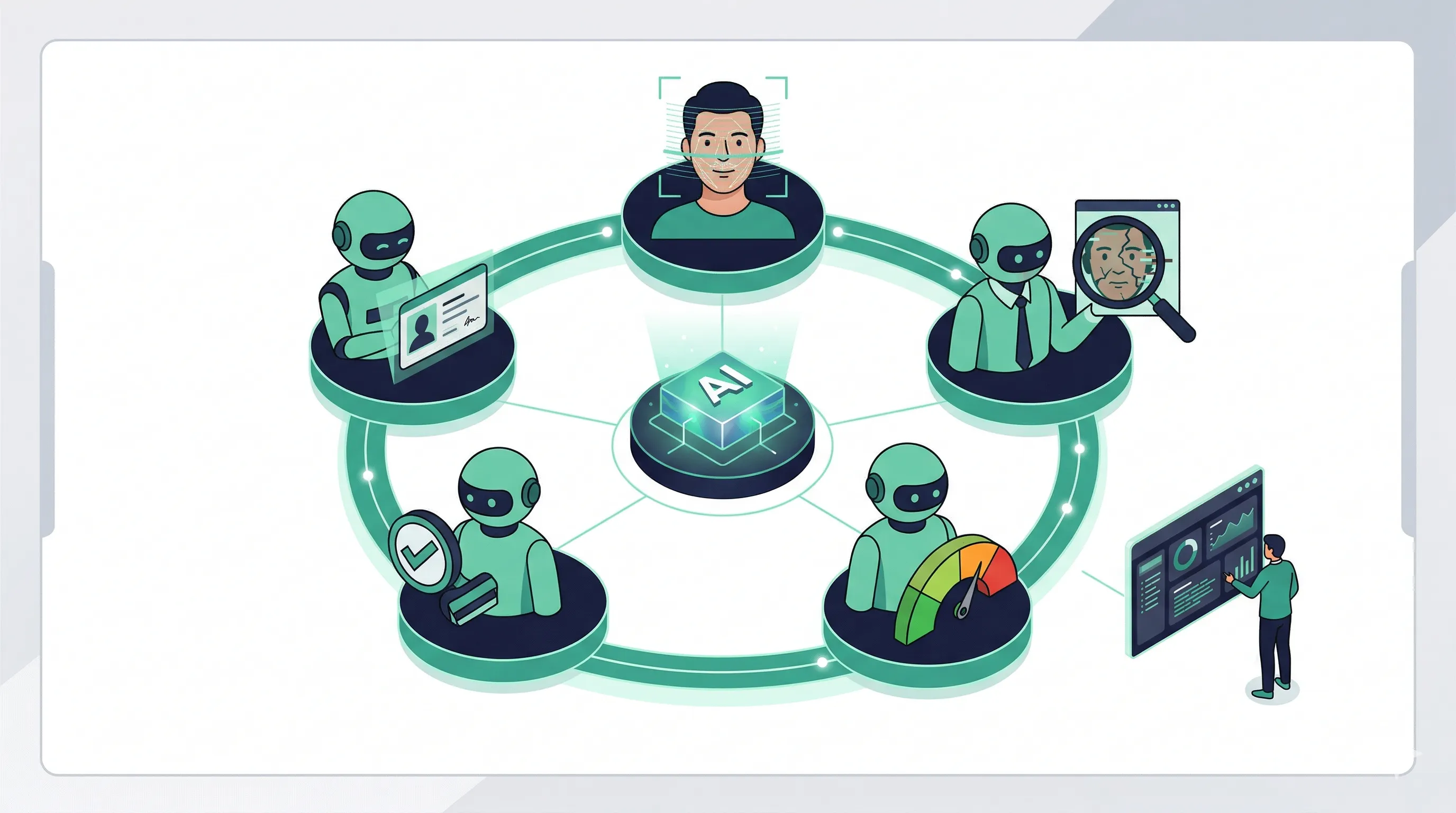
Agentic KYC: How Autonomous AI Agents Are Replacing Manual Compliance Reviews
Traditional KYC relies on human reviewers. Agentic KYC uses autonomous AI agents that detect deepfakes, assess risk, and make compliance decisions. Learn how multi-agent architecture reduces 80% of manual reviews while meeting MiCA and AMLD6 requirements.

SR 26-2: The Governance Gap in AI-Powered KYC
The Fed's new model risk guidance explicitly excludes generative and agentic AI. For banks using AI in KYC, that gap is now a compliance liability.